
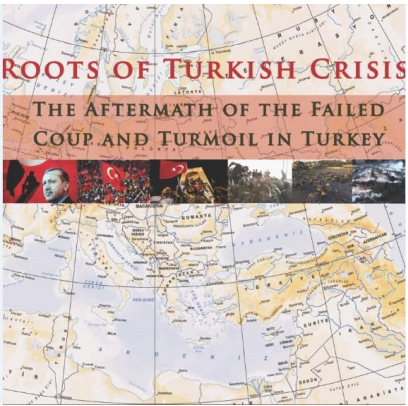
Turmoil in Turkey: The Aftermath of the Failed Coup
Jeudi 30 mars 2017, de 17h à 19h, local A-1642, Pavillon Hubert-Aquin (UQAM)
ABSTRACT / RÉSUMÉ
On July 15, 2016, a group of Turkish soldiers, apparently initiating a coup attempt, flew attack helicopters, F16s fighter jets, bombed the parliament building, and drove tanks down the streets of Istanbul and the capital city of Ankara. The subsequent violence caused almost 300 people to lose their lives, and at least two thousand more to suffer physical harm. The upheaval, quickly crushed by governmental forces, granted Turkish President Recep Tayyip Erdoǧan an opportunity to squelch his critics, effectively bolstering his authority. He promptly accused Islamic cleric Fethullah Gülen (b. 1941) and his followers of masterminding the plot, and launched a series of oppressive measures against those affiliated with the Gülen Movement, also known as Hizmet (Turkish for “service”). Individuals from a wide range of political allegiances perceived to be in opposition of the government were arrested. Most of those arrested or fired, however, were involved, or affiliated in some way, with Hizmet. In the aftermath, participants found themselves under siege, vulnerable to human rights abuses, in light of Erdoǧan’s three-month suspension of the European Convention of Human Rights. Termed “the purge,” or temizlik (Turkish for cleansing), his AKP government detained 94,889 people, arrested over 47,120, and closed or took over 149 media outlets, and over 2,000 educational institutions were shut down. Erdoǧan also labeled Gülen a traitor, and the movement a terrorist organization, creating the conditions for ordinary participants to experience acute ostracism from those around them, creating rifts between friends and family members. Refugees of the purge spoke of loss of family, friends, occupations, and property, and also of their very identity as Turks or citizens of Turkey. These series of events reflect seismic fault lines in Turkey between sectarian, ethnic, and ideological groups, and ultimately a brutal struggle over the soul of Turkey. The resulting geopolitical outcomes will transform Turkey and the larger region, already destabilized by the war in Syria, PKK militancy, and Russian aggression.— Professor Sophia Pandya is an associate professor at California State University at Long Beach, in the Department of Religious Studies. She received her B.A. from the University of California, Berkeley in Near Eastern Studies/Arabic, and her M.A. and Ph.D. from U.C. Santa Barbara in Religious Studies, with a focus on women and Islam. She specializes in contemporary Islamic movements. She published various scholarly articles, and wrote and co-edited a number of books. She is also an author of the Roots of the Turkish Crisis article recently published in the Democracy Journal where she provides insight into what’s brought Tukey to this point – and where it may head from here.
Documents joints
Auteurs-trices
Produit par
 Centre d'études sur l'intégration et la mondialisation (CEIM)
 Observatoire de l'Eurasie (ODE)
Sur le même sujet
Regards de l’IEIM – Appel à propositions 2026-2027 sur le thème de la sécurité internationale
Date limite de soumission : 30 septembre 2026

Le mandat de l’IEIM renouvelé pour cinq ans par le CA de l’UQAM
Le bulletin sera de retour en septembre, 22 juin 2026


