
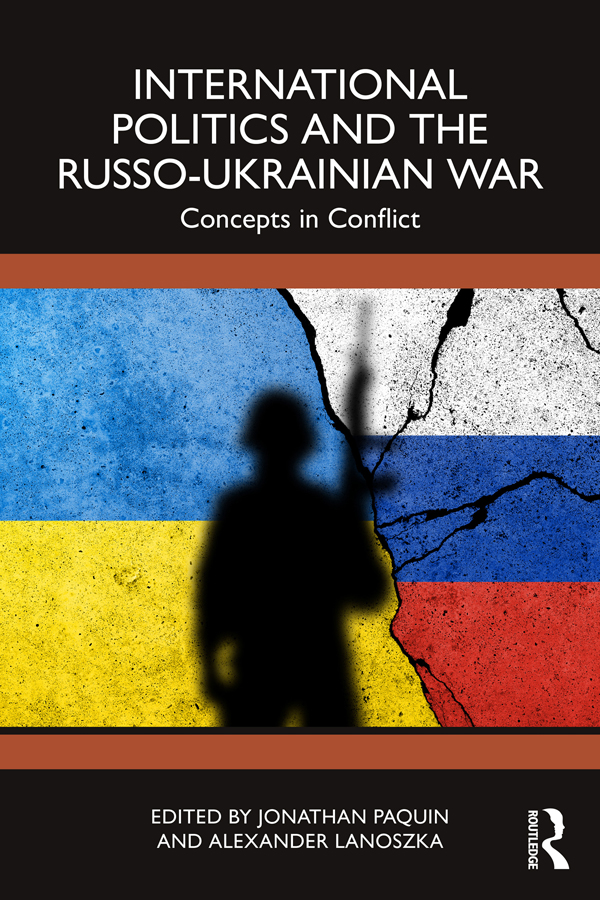
Burden-sharing – Explaining Allied Military Support to Ukraine
Dans "International Politics and the Russo-Ukrainian War", éd. Jonathan Paquin, Alexander Lanoszka, p. 141-159, Routledge, 1re édition, 2026, 29 juin 2026, Justin Massie, Nicolas-François Perron
This chapter analyzes variation in North Atlantic Treaty Organization (NATO) members’ military assistance to Ukraine (2022–2024), challenging traditional burden-sharing theories that prioritize material capacity and strategic exposure. Employing a between-effects model across 28 allies, the analysis finds that ideational and domestic factors—especially public support—outweigh interest-based drivers. Strategic alignment with the United States and threat perception of Russia also significantly predict contributions, while conventional indicators such as defense spending, arms export capacity, and geographic proximity have no effect. The overall picture marks a departure from Cold War-era burden-sharing practices, indicating that political will, shaped by democratic legitimacy and geopolitical identity, is more decisive than levels of national wealth and defense spending.
Auteurs-trices
 Justin Massie, Directeur, Réseau d’analyse stratégique (RAS)
  Nicolas-François Perron, Chercheur émergent, Réseau d'analyse stratégique (RAS)
Produit par
Sur le même sujet
Intervention américaine au Canada: un scénario à la Groenland «beaucoup plus plausible» qu’une invasion
Journal de Montréal, 26 septembre 2026, 26 octobre 2026, Justin Massie

L’autonomie stratégique du Canada au 21ème siècle : une feuille de route
Rapports stratégiques, vol. 2, no. 1, 9 septembre 2026, Justin Massie, Philippe Lagassé
Le Canada et l’Union européenne négocient une alliance stratégique d’envergure
98.5, 9 septembre 2026, Justin Massie


